

 英语
英语 中文简体
中文简体


Introduction: Why Electricity Value Increasingly Depends on Time
For many commercial and industrial users, electricity cost increasingly depends not only on how much energy is consumed, but also on when that energy is imported, exported or stored.
The metering and billing architecture must therefore preserve the time allocation of imported or exported energy. Depending on the tariff design, this may be achieved through interval records, tariff registers or another approved time-based data method.
A complete time-varying or dynamic-tariff project involves more than installing a smart meter. It requires alignment between:
- Price and tariff intervals
- Meter recording intervals or tariff registers
- Meter clocks and time zones
- Data collection and validation
- Tariff and billing calculations
- EMS optimisation data
- Customer-facing reports
The central project question is:
What data, timing and system architecture are required before time-varying or dynamic electricity prices can be billed accurately and used for load optimisation?
1. What Are Time-Varying and Dynamic Electricity Tariffs?
Time-varying electricity tariffs allocate different prices or charges to different time periods, operating conditions or market events.
They may include:
- Time-of-use tariffs with predefined price periods
- Critical-peak or event-based pricing
- Hourly or sub-hourly market-linked tariffs
- Day-ahead or intraday price-linked contracts
- Other supplier-defined variable pricing structures
In the European Union, a dynamic electricity price contract has a more specific regulatory meaning. It is an electricity supply contract that reflects price variation in spot markets, including day-ahead and intraday markets, at intervals at least equal to the applicable market-settlement frequency.
Time-of-use pricing, dynamic electricity pricing, demand-based charges and formal demand-response programmes may interact, but they are not the same mechanism.
Pricing and Charge Mechanisms
|
Pricing or charge mechanism |
How it changes |
Typical meter or processing requirement |
|
Fixed energy price |
Changes infrequently |
Total imported energy |
|
Time-of-use tariff |
Uses predefined tariff periods |
Tariff registers or interval data |
|
Critical-peak or event-based pricing |
Applies special prices during defined periods or events |
Event-aligned tariff or interval data |
|
Hourly market-linked pricing |
Follows hourly market or supplier prices |
Time-aligned interval-energy data |
|
Intraday or short-interval market-linked pricing |
Tracks shorter market-linked price periods |
Interval data aligned with the applicable contract and pricing rules |
|
Day-ahead price-linked contract |
Uses prices published before delivery |
Interval data mapped to the applicable day-ahead price |
|
Demand-based charge component |
Depends on peak power or demand |
Maximum-demand values and defined demand intervals |
A demand-based charge component is not simply another form of dynamic energy pricing. It may exist alongside a fixed, time-of-use or dynamic energy price.
The actual pricing and billing interval must be defined by the supplier contract and applicable market rules.
EU electricity-market rules support a 15-minute imbalance-settlement framework, but this does not mean every retail contract, customer invoice or meter recording interval must use the same granularity. Actual billing still depends on national rules, supplier systems, customer contracts and the metering architecture.
2. Dynamic Tariffs Versus Demand-Side Flexibility
Dynamic tariffs encourage customers to change consumption voluntarily in response to price signals.
Formal demand-side flexibility programmes may involve activation instructions, contracted capacity, baseline methods, response verification and separate settlement requirements.
|
Dynamic or time-varying tariff |
Demand-side flexibility programme |
|
Primarily price-driven |
Primarily dispatch- or programme-driven |
|
Customer decides whether and how to respond |
Response may be requested or contracted |
|
Main objective is bill optimisation |
Main objective is a verified grid or market response |
|
Price and billing intervals are central |
Baseline and activation windows are central |
|
Supplier and billing chain are central |
Aggregator, utility or programme-settlement chain may be central |
|
Meter data supports price allocation |
Meter data supports response verification |
Dynamic tariffs may encourage load shifting, but formal demand-response or flexibility programmes require additional baseline, activation and verification rules.
The two mechanisms can overlap. A battery, EV fleet or industrial process may respond to both changing prices and flexibility instructions, but the billing, control and settlement chains remain different.
3. How Price Intervals Must Align with Meter Intervals
Accurate dynamic-tariff billing requires meter data and price data to be aligned through a clearly defined, traceable and auditable method.
Several time intervals may exist within the same project:
- Price-publication interval
- Tariff interval
- Meter recording interval
- Meter register-refresh interval
- Data-collection interval
- HES collection interval
- MDM aggregation interval
- Billing interval
- EMS polling interval
- Market-settlement interval
These intervals are not automatically identical.
If the price changes hourly while the meter records 15-minute energy intervals, the billing architecture may aggregate four validated intervals before pricing or apply the same hourly price to each of the four intervals.
The selected method should produce an equivalent, traceable and auditable result under the applicable tariff rules.
A simplified data relationship may be:
Hourly price
→ Four validated 15-minute energy intervals
→ Approved aggregation or interval-level price application
→ Tariff calculation
→ Customer bill
The project should define:
- Whether timestamps represent interval start or interval end
- Whether timestamps use UTC or local time
- How partial intervals are treated
- How repeated or missing clock periods are handled
- How short intervals are aggregated
- How late or corrected data is rebilled
- Which system performs the price assignment
- Which tariff and contract version applies
Fast polling does not automatically create a billing interval.
A gateway may read a meter every second, while the supplier bills the customer using validated 15-minute or hourly energy records.
4. Which Meter and Processing Data Is Needed?
The required data depends on the pricing design, billing rules, meter role, system architecture and optimisation objective.
Not every project requires every data field, and not every field is necessarily generated by the meter.
4.1 Billing-Critical Meter and Processing Data
Billing-critical information may include:
- Interval import energy
- Interval export energy
- Tariff-register values
- Timestamp
- Meter or measurement-point identifier
- Measurement interval
- Unit of measurement
- Import or export direction
- Meter clock status where available
- Time-zone information
- Tariff-period assignment
- Price source and price identifier
- Tariff-plan version
- Tariff-calendar version
- Billing-rule version
- Data-quality or validation status
- Actual, missing, estimated, substituted or corrected-data indication
- Original and corrected-record references
- Import-price and export-credit treatment
Not every field is necessarily produced by the meter. Validation flags, tariff assignments, price identifiers and correction statuses may be added by the HES, MDM, tariff engine or billing system.
For example:
- The meter may produce interval energy, tariff-register values and timestamps.
- The HES may collect device and communication information.
- The MDM may add validation, estimation, substitution or correction statuses.
- The tariff engine may assign tariff periods, price identifiers and tariff versions.
- The billing system may generate final billing records and rebilling references.
This distinction is important because a meter specification alone does not define the complete billing-data model.
4.2 Optimisation Data
An EMS or other optimisation platform may use:
- Near-real-time active power
- Load profiles
- Maximum demand
- Import and export power
- Asset-level energy data
- BESS charging and discharging data
- EV charging power
- PV generation
- Forecast consumption
- Forecast price data
- Equipment constraints
- Site operating schedules
Optimisation data may be collected more frequently than official billing data.
4.3 Diagnostic Data
Diagnostic data may include:
- Meter clock status
- Communication status
- Device events
- Register availability
- Firmware version
- Tariff-calendar version
- Data gaps
- Reset or restart events
- Synchronisation status
- Communication retries
- Device replacement or configuration changes
Diagnostic information helps explain why billing or optimisation data may be missing, delayed or inconsistent.
5. Interval Data Is Not the Same as Real-Time Data
Different data types serve different purposes.
|
Data type |
Typical use |
|
Billing interval data |
Invoice calculation |
|
Near-real-time meter data |
EMS monitoring and operational control |
|
Tariff-register data |
Time-of-use billing |
|
Estimated data |
Temporary billing continuity |
|
Corrected data |
Recalculation after data recovery |
|
Validated historical data |
Final billing or market process |
|
Forecast data |
Load and cost optimisation |
Near-real-time operational data should not automatically be treated as validated billing data.
A C&I site may use second-level power data for control while the supplier bills the customer using validated 15-minute or hourly energy intervals.
Near-real-time data may support:
- Battery-control decisions
- EV charging schedules
- Peak-demand management
- HVAC optimisation
- Operator dashboards
Billing data generally requires additional consistency, validation, retention and audit controls.
A project may therefore use separate data paths:
Operational path:
Meter or controller
→ Communication module or gateway
→ EMS
→ Load optimisation
Billing path:
Official meter
→ Data collection
→ Validation and aggregation
→ Tariff calculation
→ Billing
The same meter may contribute to both paths, but the collection frequency, validation status and official acceptance of the data may differ.
6. Meter Clock, Time Zone and Daylight-Saving Time
Time accuracy is critical in time-varying and dynamic-tariff billing.
A correct energy value assigned to the wrong price interval can still produce an incorrect bill.
Projects should confirm:
- Meter clock source
- UTC or local-time configuration
- Time-zone setting
- Daylight-saving-time rules
- Clock-drift tolerance
- Synchronisation frequency
- Remote time-correction method
- Tariff-calendar update method
- Leap-year and calendar handling
- Timestamp convention
- Interval-start and interval-end definitions
Daylight-Saving-Time Transitions
Daylight-saving-time changes may create:
- A missing local-time hour
- A repeated local-time hour
- Duplicate timestamps
- Unequal daily interval counts
- Tariff-period ambiguity
The meter, collection system, data-management platform, tariff engine and customer portal must interpret these transitions consistently.
Using UTC internally can reduce ambiguity, but the billing system must still apply and display the correct local tariff period.
Clock Drift
A drifting meter clock may allocate measured energy to the wrong price interval even when the energy measurement itself remains accurate.
Projects should define:
- Maximum acceptable clock drift
- Synchronisation source
- Correction frequency
- Treatment of corrected timestamps
- Audit records for time changes
- Responsibility for time-source management
7. From Smart Meter to Customer Bill
Dynamic-tariff billing may involve several functional stages:
Smart meter
→ Communication network or gateway
→ Data collection
→ Data validation and aggregation
→ Tariff calculation
→ Billing
→ Customer portal or invoice
A common architecture may use:
Smart meter
→ HES
→ MDM
→ Tariff engine
→ Billing system
→ Customer portal
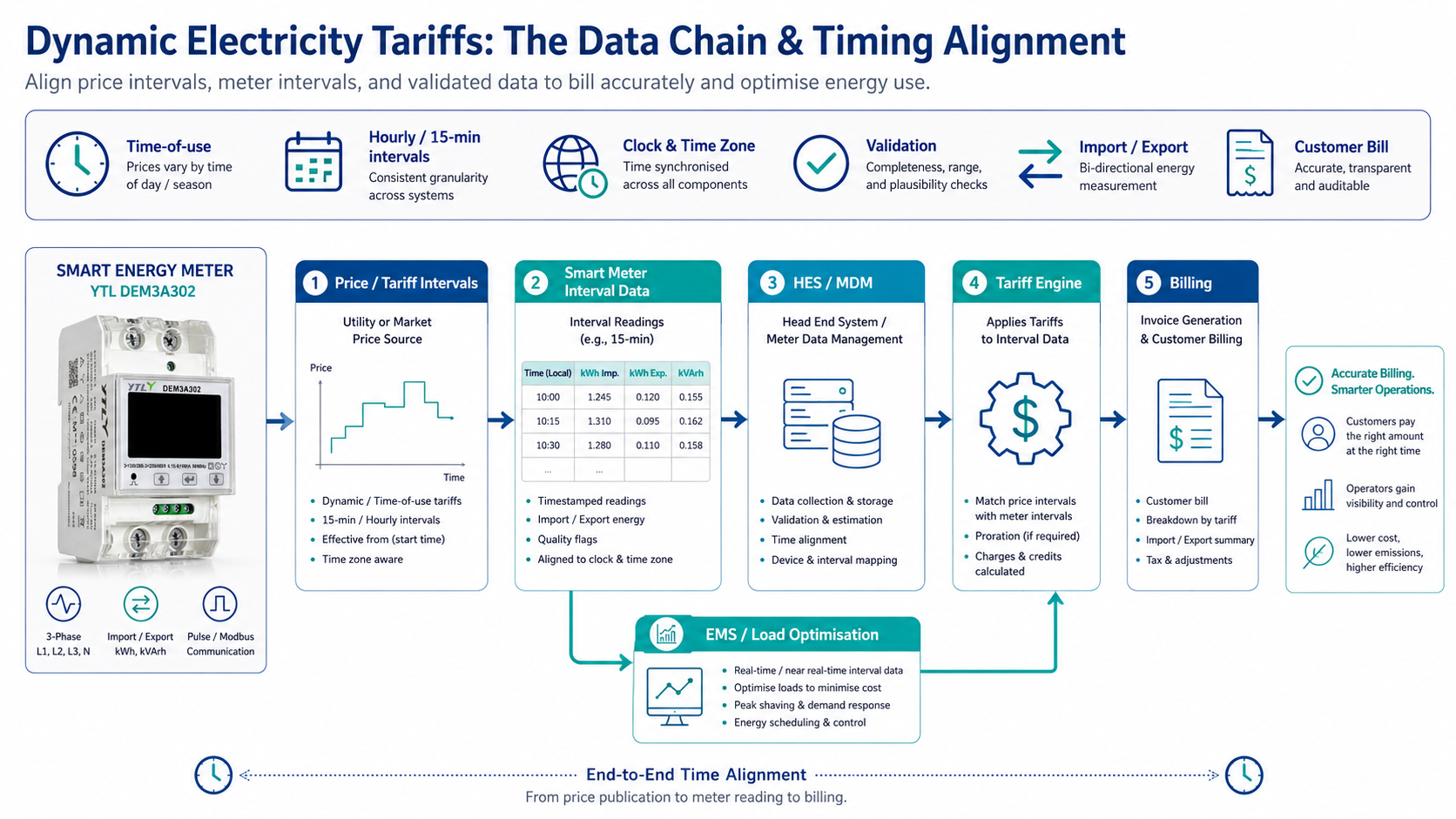
However, this is not a globally mandatory or universal system design.
The functional roles shown in this architecture may be implemented as separate systems or combined within a utility, supplier, meter-data hub or software platform.
In some projects:
- HES and MDM functions may be combined.
- The tariff engine may be integrated into the billing platform.
- Meter data may pass through a national or regional data hub.
- A communication module may replace a separate gateway.
- A supplier may outsource meter-data management.
- Private C&I sub-metering data may be used only by the EMS and not by the official billing chain.
The exact architecture depends on:
- The market
- The meter role
- The supplier
- The meter operator
- The applicable regulatory framework
- The contract
- The project design
Smart Meter
The smart meter records supported energy and electrical data according to its configured intervals, tariff registers and clock.
Communication or Collection Layer
The communication layer transfers data upstream and may buffer records during temporary communication interruptions.
HES or Device-Management Functions
These functions may manage:
- Meter communication
- Data retrieval
- Device addressing
- Remote configuration
- Communication status
- Device events
MDM or Meter-Data Management Functions
These may include:
- Data validation
- Missing-interval identification
- Approved estimation or substitution
- Interval aggregation
- Correction history
- Data preparation for billing
Tariff Calculation
The tariff function matches validated energy data with:
- Applicable prices
- Tariff periods
- Contract versions
- Import and export rules
- Taxes or other charge components where applicable
Billing
The billing function applies the customer contract and generates the invoice.
Customer Portal
A customer-facing platform may display:
- Interval consumption
- Applicable price intervals
- Actual and estimated readings
- Import and export values
- Billing-period summaries
- Tariff changes
- Corrections
- Cost trends
All stages must use consistent units, timestamps, scaling and interval definitions.
8. What Happens When Meter Data Is Missing or Delayed?
Dynamic and time-varying pricing increases the importance of data-quality status because each missing interval may be associated with a different price.
Common data problems include:
- Missing intervals
- Delayed uploads
- Communication interruptions
- Duplicate records
- Incorrect timestamps
- Meter resets
- Estimated values
- Substituted values
- Scaling errors
- Late corrections
The project should define:
- Whether temporary billing uses estimated data
- How estimates are calculated
- How estimated values are identified
- Whether bills are recalculated after actual data arrives
- Who approves corrected records
- How original and corrected records are retained
- How customers can distinguish actual, estimated and corrected values
- How disputes are handled
- Which tariff and price version is applied during rebilling
Typical status labels may include:
- Actual
- Validated
- Missing
- Estimated
- Substituted
- Corrected
- Rejected
A corrected interval should not silently overwrite the original record where traceability or auditability is required.
9. Import and Export Pricing May Follow Different Rules
Dynamic import pricing does not automatically mean that exported energy receives the same price or follows the same interval rules.
A project should separately confirm:
- Import price source
- Export compensation method
- Whether import and export are priced separately
- Whether import and export use separate contracts
- Whether separate registers or signed values are used
- Treatment of simultaneous import and export
- Export restrictions
- Negative-price treatment where applicable
- Feed-in tariff
- Export credit
- Market-linked export compensation
- Taxes, network charges or levies
- Applicable billing and settlement intervals
For example, imported electricity may follow an hourly market-linked contract while exported PV or battery energy receives:
- A fixed feed-in tariff
- A supplier-defined export credit
- A different market-linked price
- No compensation under certain conditions
The meter and upstream systems must preserve the import/export direction and apply the correct contract and pricing rules.
10. How C&I Users Can Optimise Loads Under Time-Varying Prices
Changing prices can help C&I users adjust the timing of electricity consumption, generation or storage operation.
The available opportunities depend on:
- Operational constraints
- Equipment capability
- Tariff design
- Price forecasts
- Network charges
- Demand charges
- Export rules
- Control-system capabilities
Battery Energy Storage
A BESS may be scheduled to:
- Charge during lower-price periods
- Discharge during higher-price periods
- Reduce grid import during expensive intervals
- Increase PV self-consumption
- Support demand-charge management
The optimisation model should consider:
- Battery efficiency
- State of charge
- Power limits
- Energy capacity
- Degradation cost
- Auxiliary consumption
- Demand charges
- Export restrictions
- Import and export price differences
EV Fleet Charging
EV charging may be shifted within vehicle-availability and departure constraints.
Possible strategies include:
- Charging during lower-price periods
- Avoiding expensive peak intervals
- Coordinating multiple chargers
- Limiting site demand
- Using day-ahead price forecasts
- Increasing charging during periods of high PV output
HVAC and Refrigeration
HVAC and refrigeration may support price optimisation through:
- Pre-cooling
- Thermal storage
- Temperature-setpoint adjustment
- Compressor scheduling
- Chiller sequencing
These strategies must remain within comfort, safety, process and product-quality limits.
Pumps, Compressors and Industrial Processes
Some industrial operations may be moved to lower-price periods when production schedules allow.
Examples may include:
- Pumps
- Compressed-air systems
- Water treatment
- Batch processes
- Thermal processes
- Non-continuous production lines
PV Self-Consumption
A price-aware EMS may combine price data with PV forecasts to decide whether electricity should be:
- Consumed directly
- Stored
- Exported
- Used for EV charging
- Used by flexible industrial loads
Energy-price arbitrage, self-consumption optimisation, demand-charge management and demand-response revenue can overlap, but they use different price, control, contract and settlement rules.
11. Why Sub-Metering Matters for Tariff Optimisation
The official billing meter shows the total energy imported or exported at the billing boundary.
Sub-metering helps identify which equipment, department or process caused consumption during high-price periods.
Useful measurement points may include:
- Utility incoming supply
- Production lines
- HVAC systems
- Refrigeration
- EV charging
- Battery energy storage
- PV output
- Pumps and compressors
- Tenant circuits
- Departmental circuits
Sub-metering can help a C&I user determine:
- Which asset operated during an expensive interval
- Which process caused the site peak
- Whether EV charging occurred during the intended low-price period
- Whether the BESS produced the expected net-load effect
- Whether auxiliary consumption reduced storage savings
- Which department should receive an internal cost allocation
- Whether optimisation shifted cost rather than reduced it
Private sub-metering does not automatically replace an official billing meter.
Whether a meter or data source is accepted for formal billing depends on:
- The supplier
- The utility
- The meter operator
- Applicable legal-metrology requirements
- The contract
- The regulatory framework
- The billing-system architecture
12. Data Access, Customer Transparency and Contract Risk
Dynamic-price contracts may expose customers to both opportunities and price volatility.
Before a customer enters a dynamic electricity price contract, the relevant supplier should clearly explain the contract’s opportunities, costs and risks and obtain customer consent where required.
Customers should be able to understand:
- Dynamic price-calculation method
- Price source and publication time
- Applicable price interval
- Exposure to price spikes and bill volatility
- Fixed network charges
- Taxes and fees
- Demand charges
- Import and export price differences
- Meter and data requirements
- Actual and estimated-data treatment
- Switching conditions
- Termination conditions
- Rebilling rules
- Potential benefits and risks of automated optimisation
- Customer-consent requirements where applicable
Customers may need data access through:
- Supplier portals
- Mobile applications
- APIs
- Downloadable interval-data files
- Billing statements
- EMS dashboards
- Scheduled reports
Useful customer-facing information may include:
- Energy consumed in each interval
- Price applied to each interval
- Price source
- Import and export values
- Actual versus estimated data
- Tariff changes
- Data corrections
- Peak-demand values
- Export credits
- Billing adjustments
Dynamic tariffs create trust only when customers can understand which energy interval was charged at which price.
13. Common Integration Risks
A dynamic-tariff project can fail even when the meter measures energy accurately.
Common risks include:
- Meter interval and price interval mismatch
- Incorrect time-zone configuration
- Incorrect daylight-saving-time handling
- Import and export direction reversal
- Missing tariff-calendar update
- Price-source version mismatch
- HES and MDM aggregation differences
- Estimated data not clearly identified
- EMS timestamps differing from billing timestamps
- Incorrect CT ratio, shunt scaling or register scaling
- Register-map changes after firmware updates
- Meter clock drift
- Duplicate or missing interval records
- Gateway buffering without correct recovery sequencing
- Customer-portal values differing from invoice values
- Near-real-time data being treated as validated billing data
- Tariff-engine rules not matching the customer contract
- Export compensation being assumed to match import pricing
- Late corrected data not triggering appropriate rebilling
- A technically suitable meter not being accepted for formal billing
An end-to-end pilot should test the complete chain from meter measurement to tariff calculation, billing output and customer presentation.
14. Dynamic Tariff Metering Checklist
|
Selection area |
What to confirm |
|
Pricing mechanism |
Fixed, time-of-use, event-based, hourly or market-linked |
|
Contract type |
Whether it is a supplier-defined variable tariff or a regulatory dynamic electricity price contract |
|
Price source |
Market, supplier or tariff-calendar source and version |
|
Price interval |
Fifteen-minute, hourly or another defined period |
|
Meter-data path |
Interval records, tariff registers or another approved method |
|
Meter interval |
Recording, storage and reporting interval |
|
Interval alignment |
How meter intervals map to price intervals |
|
Time source |
Meter, communication module, HES or central platform |
|
Time zone |
UTC or local time |
|
DST handling |
Repeated and missing local-time intervals |
|
Import and export |
Separate registers or signed values |
|
Import pricing |
Source and applicable contract rule |
|
Export pricing |
Export credit, feed-in price or market-linked compensation |
|
Tariff registers |
Availability and number of supported periods where required |
|
Data status |
Actual, missing, estimated, substituted or corrected |
|
HES or collection system |
Meter communication and collection compatibility |
|
MDM or validation function |
Validation, estimation, aggregation and correction rules |
|
Tariff engine |
Price matching and tariff-calendar logic |
|
Billing system |
Invoice calculation and rebilling capability |
|
EMS data |
Required real-time or near-real-time values |
|
Data access |
Portal, API, export or report |
|
Data retention |
Billing, audit and dispute period |
|
Communication |
Physical interface and protocol |
|
Register map |
Addresses, units, scaling and data types |
|
Clock accuracy |
Drift tolerance and synchronisation method |
|
CT or shunt scaling |
Complete measurement-chain configuration |
|
Billing acceptance |
Whether the meter and its data are accepted by the supplier, utility, meter operator or billing party |
|
Legal metrology |
Applicable certification, sealing, verification and regulatory requirements |
|
Rebilling |
Treatment of late, estimated and corrected interval data |
|
Contract version |
Tariff plan, pricing rule and customer-contract version |
|
Cybersecurity |
Authentication, access control and firmware management |
|
Pilot test |
Meter-to-bill and meter-to-EMS validation |
Applicable legal-metrology and billing-acceptance requirements vary by country, contract, meter role and system architecture.
No single certification should be presented as a universal requirement for all dynamic-tariff projects.
The meter should be selected only after the pricing structure, meter role, data method, billing acceptance conditions and system responsibilities have been defined.
15. How YTL Can Support Initial Meter Evaluation
Zhejiang Yongtailong Electronic Co., Ltd. (YTL) provides selected energy-metering products and data interfaces that may form part of time-of-use, dynamic-tariff and C&I energy-management architectures, depending on the meter model, legal-metrology requirements, billing role and overall system design.
Depending on the selected model and project requirements, YTL can support:
- Initial meter-model selection
- Voltage and current-range review
- Review of customer-proposed CT ratios, secondary inputs and meter-side requirements
- Review of customer-specified interval-energy, storage and reporting requirements
- Import and export measurement review
- Communication-option confirmation
- RS485 and Modbus interface review
- Register-map and data-format review
- Sample testing support
- Meter-to-gateway or controller integration review
- Initial technical discussion of customer-proposed measurement points
Product capabilities vary by model, hardware, firmware, current-sensing arrangement, tariff configuration, communication interface and register-map version.
Tariff-calendar functions, interval-data capability, time synchronisation, communication implementation, legal-metrology scope and platform compatibility must be confirmed for the selected model and project.
YTL does not claim that every meter model supports every dynamic-tariff architecture, HES, MDM, tariff engine or billing platform.
Final acceptance of a meter and its data for customer billing remains subject to the relevant supplier, utility, meter operator, regulatory framework and billing-system requirements.
YTL supports the field-level measurement and data-output layer. Tariff design, price publication, HES and MDM implementation, tariff calculations, billing, customer-contract management and EMS control strategies remain the responsibilities of the relevant suppliers, utilities, software providers, system integrators and project stakeholders.
16. Frequently Asked Questions
What is the difference between a time-of-use tariff and a dynamic electricity price contract?
A time-of-use tariff normally uses predefined price periods. In the European Union, a dynamic electricity price contract reflects price variation in spot markets, including day-ahead and intraday markets, at intervals at least equal to the applicable market-settlement frequency.
Is a demand charge a type of dynamic electricity tariff?
Not necessarily. A demand charge is generally a separate charge based on peak demand or another demand metric. It may exist alongside a fixed, time-of-use or dynamic energy price.
What meter data may be needed for dynamic pricing?
Depending on the contract and architecture, relevant meter data may include interval import and export energy, timestamps, tariff registers, meter identifiers and direction values. Validation, tariff assignment, price identifiers and correction statuses may be generated by upstream systems rather than by the meter.
Can tariff registers be used instead of interval data?
In some time-of-use projects, tariff registers may support billing. Market-linked or more granular pricing may require interval data. The accepted method depends on the supplier, contract, meter role and billing system.
Are real-time meter values used directly for billing?
Not necessarily. Near-real-time values may support EMS optimisation, while billing generally uses validated interval records or approved tariff-register data.
How are hourly prices matched with 15-minute meter data?
The billing architecture may aggregate four validated 15-minute intervals before pricing or apply the same hourly price to each of the four intervals. The selected method should produce an equivalent, traceable and auditable result under the applicable tariff rules.
Why does daylight-saving time matter?
Daylight-saving changes may create a missing or repeated local-time hour. Incorrect handling can assign otherwise correct energy values to the wrong price interval.
Does dynamic import pricing determine the export price?
No. Imported and exported energy may use different contracts, tariffs, credits or market-linked prices.
Are HES and MDM always separate systems?
No. Their functions may be implemented as separate systems or combined within a utility, supplier, meter-data hub or software platform.
Can a Modbus meter support tariff optimisation?
A Modbus meter may provide power and energy data to a gateway or EMS, depending on the selected model and register map. Protocol support alone does not establish acceptance by a supplier, HES, MDM or billing platform.
Does a smart meter automatically optimise loads?
No. The smart meter measures and outputs data. Optimisation is normally performed by an EMS, controller, BMS, charging-management platform or another control system.
What should buyers confirm before selecting a meter?
Buyers should confirm the pricing mechanism, interval or tariff-register method, time synchronisation, import/export treatment, communication interface, legal-metrology scope, billing acceptance and integration requirements.
17. Conclusion
Time-varying and dynamic electricity pricing connect several elements:
Time + energy data + price data + contract rules
The meter records supported energy values and time information. Collection and data-management functions retrieve, validate and prepare the records. The tariff function applies the applicable price or charge mechanism. The billing system produces the customer invoice, while the EMS may use faster operational data to optimise loads, storage and EV charging.
Dynamic-tariff projects succeed when:
- Time allocation is accurate
- Energy data is traceable
- Price data is version-controlled
- Import and export rules are defined
- Billing acceptance is confirmed
- Customer risks and contract terms are transparent
- Operational and billing data are not confused
Reliable interval or tariff-register measurement is an important foundation, but accurate billing depends on the complete meter-to-bill architecture.
References
- Directive (EU) 2019/944 of the European Parliament and of the Council of 5 June 2019 on common rules for the internal market for electricity, Article 2(15), definition of a dynamic electricity price contract, and Article 11.
- Directive (EU) 2024/1711 of the European Parliament and of the Council of 13 June 2024 amending Directives (EU) 2018/2001 and (EU) 2019/944 as regards improving the Union’s electricity market design.
- Commission Implementing Regulation (EU) 2023/1162 of 6 June 2023 on interoperability requirements and non-discriminatory and transparent procedures for access to metering and consumption data.
- Regulation (EU) 2019/943 of the European Parliament and of the Council of 5 June 2019 on the internal market for electricity and the Union framework concerning 15-minute imbalance-settlement periods.


